|
After doing this transistor
circuit development at RCA labs in Princeton, in 1951 I teamed with a
senior engineer in the design and construction of a 5,120 bit (not byte)
memory system for the Air Force Cambridge Research Center using Jan
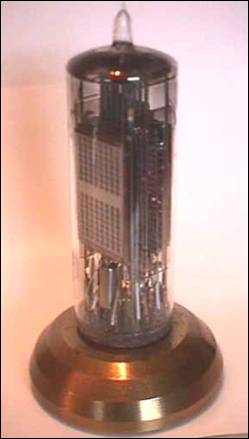
Rajchman’s SB256 Selectron tube. (The senior engineer – remember that I
was only 23 at the time - was Igor Grossdoff, who was a Russian, perhaps
55 or 60 years old. He was a friend of David Sarnoff, another Russian
émigré). In the late 1940s, the principal random access memory device
was the Williams tube in which 256 bits were stored as charges on the
phosphor of 5” cathode ray tubes. RCA’s Rajchman invented the Selectron
tube as the first “fully digitally accessed” memory device, to replace the
analog-accessed Williams tube. We developed a 5,120 bit memory system for
the Air Force Cambridge Research Center for $750,000! These weren’t
really “computer-reliable, since the MTBF wasn’t very good. The $750,000
that the Air Force paid works out to about $146.48 per bit. The pain of
the high price was offset, however, by the joy of its 16 microsecond high
speed access.
Returning to Camden in 1952 I
was manager of an engineering team which developed the "highs
speed" random access magnetic core memory for BIZMAC, RCA's first
commercial computer. The system stored 14,336 bits in seven 6' relay
racks.
______________
|