|
What
recollections can you share on the details of the very successful TO92
plastic case style by Motorola?
By the
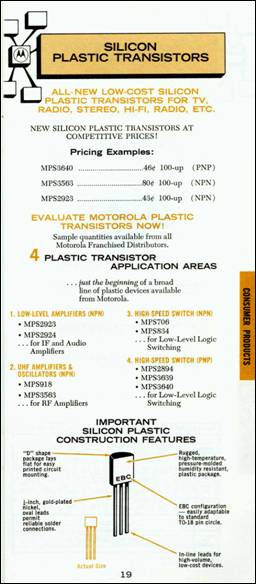
time we were ready to put the plastic transistor line into volume, we were
designing for manufacturability, and cost. By now, we had mastered metal
over oxide bonding pads. The bonding rates on the to92 line were about 5x
faster than on TO18 or TO5. Also we were selling plastic transistors at
20% of the price of TO5. Specs were deliberately different, and much
looser; even though in reality, the chips were more or less the same.
Target market was TV, radio, other consumer applications. We wanted 100%
yield, and no effect on our existing business in TO18, and TO 5.
The geometry
for the plastic transistors was interdigitated with large bonding pads.
Very easy to hit. The bonding machines were still controlled by an
operator; it would be several years before the bonders were fully
automatic. Nevertheless the standard rate was one per second, 3600 units an
hour. The 2N numbers were 2N3904, and 3905 NPN, 2N3906 and
3907, PNP. The earlier Star geometries were much more difficult to hit at
high speed.
Note: Motorola was one of the
first U.S. companies to introduce a commercial all-transistor TV in the mid
1960s. According to Wilf, this product used TO92 transistors extensively.
Go
To Corrigan Oral History, Page 11
|