|
A SURVEY OF EARLY POWER TRANSISTORS by Joe A. Knight PHILCO 1950s GERMANIUM POWER TRANSISTORS
|
|
|
|
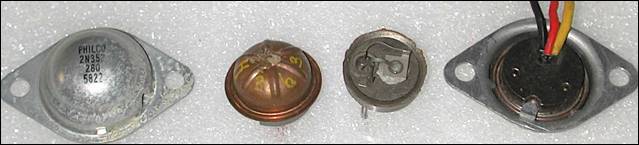
ABOVE, L-to-R: The first 'half-dome' Philco Power Transistor types issued were the the in-house numbered "T1040" and the "T1041", both alloy-junction PNP. These came out by the end of 1956 and look identical to the devices shown above. In early 1957 their RETMA registered counterparts were released. The first item shown, the "2N352" (similar to the T1040), was rated at 7 watts of dissipated power. Also released was the "2N353" (similar to the T1041), and rated at 12 watts of power. These unique 'TO-27' devices had an aluminum clamp securing the copper body (see second item, marked 'H363' on top) which itself was half-dome with radial ribs on top. This allowed for some air-borne heat convection on top while the main heat conduction came through the copper bottom face (the last item). The actual Germanium element structure, shown in the third item, is not unlike most other manufacturers’ construction methods. All these earlier Philco types used three colored flexible wire leads for soldering directly onto circuit boards. So, having decided against using the more common TO-3 car-radio package that most companies had began using in 1956, Philco became the only manufacturer to utilize this unique TO-27 package - nor did this decision likely help them out in the long run. By the end of the 50's Philco was in dire financial straights as company sales dropped to record lows.
|
|
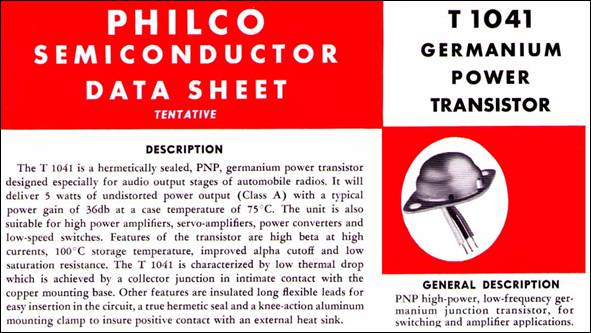
Above is a section of a Philco T 1041 Germanium Power Transistor Data Sheet, Dated 10-56.
|
|
COPYRIGHT © 2007 by Jack Ward. All Rights Reserved. http://www.transistormuseum.com/ Joe A. Knight Early Power Transistor History – PHILCO Page 2 |