|
A SURVEY OF EARLY POWER TRANSISTORS by Joe A. Knight MALLORY 1950s GERMANIUM POWER TRANSISTORS
|
|
|
|
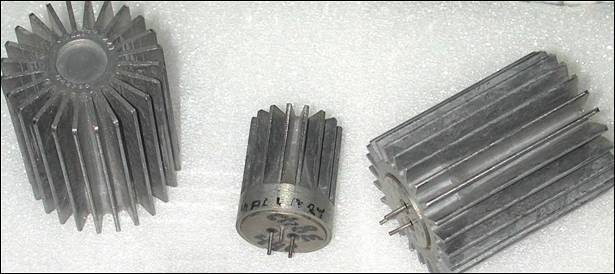
ABOVE, L-to-R: The first power transistor, stamped on top "Mallory" and "441" and produced in the 20th week of 1956, would appear to be a spec type "441-C-C" in the 2" long heat sink. The middle item is a likely pre-production item, hand marked on the bottom '442', so would appear to be a spec type "442-C-D" with the shorter 1" long heat sink. The last item is also a likely pre-production item, hand marked on the bottom '440', so it would appear to be a spec type "440-C-C" in the 2" long heat-sink. No date codes were marked on the last two items but they did have likely sample numbers and are likely from late 1955. Most all the 'production' items are stamped with the Mallory name, series number, and the manufacturer’s code (Mallory is #235) with the typically following three digit date-code. These large heat-sink devices must have been costly to manufacture and may also have put Mallory at a cost and price disadvantage with their competition. Although a corporate profit margin may be a secondary consideration in the early stages of any new device development program.
Some of my Mallory devices are dated as late as January of 1957 and so are likely at about the end of Mallory's power transistor endeavor. Mallory never did seem to get the production line into full capacity - possibly they always were just 'pilot-line' products. Reliability may also have been an issue as it was with other manufacturers who over-compensated for limited designs with larger and larger heat-sinks. What is unusual is that in none of the Mallory ads, from 1954 through 1957, was there ever any mention of their research or intention of making power transistors part of their product line. It's almost as if they were never sure of its probability of success even from the start. Mallory in 1956 registered with RETMA another power transistor listed as a “2N230”, rated at 15 watts dissipation, so was likely based upon their “441” transistor design technology. One transistor listing indicates this could also be a TO-3 type device, but regardless it likely was never produced. From then on they did not get into the Power Transistor business again. Mallory’s power transistor program truly is almost one of those missing pieces of transistor history.
Sources: H.E. Marrows' 1956 book, "Transistor Engineering" and some Signal Corps spec sheets from 1956.
|
|
COPYRIGHT © 2007 by Jack Ward. All Rights Reserved. http://www.transistormuseum.com/ Joe A. Knight Early Power Transistor History – MALLORY Page 2 |