|
A SURVEY OF EARLY POWER TRANSISTORS by Joe Knight THE POWER TRANSISTOR BELL TELEPHONE LABS AND WESTERN ELECTRIC
|
|
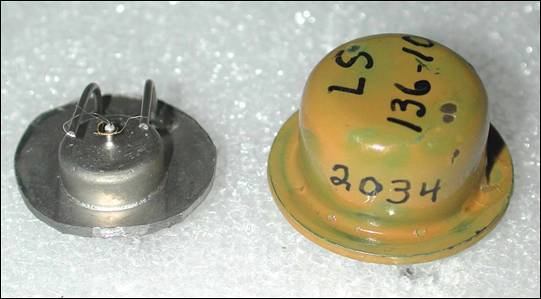
BTL was looking to develop even higher frequency transistors for use within the telephone system. At this same time core memory was becoming well developed so Bell Labs wanted solid-state core memory drivers. By 1955 work had begun on the BTL 2034 PNP Alloy Junction Power Transistor, pictured below. As shown on the left, its germanium pellet was much reduced in size from earlier Power Transistors, mounted on a very small short riser above the raised emitter platform. It's power dissipation was reduced to about 1/2 watt but it's smaller element design and closer spacing meant it could operate at the higher frequencies needed for core memories. This housing also used a threaded bolt attachment on the bottom, the same as the W.E. 6A design.
|
|
|
|
By late 1955, the BTL 2034 had evolved into the W.E. 6B, a Germanium PNP Alloy Junction medium-power carrier frequency transistor with 1/2 watt of dissipation. This device looked similar to the W.E. 6A transistor. It was at about this time that Bell Labs at Murray Hill dropped the 'M' prefix transistor designation and just used a sequential 4-digit number to denote each new transistor design. Other Bell research shops were also coming up with their own designs.
Go To BTL/Western Electric Early Power Transistors, Page 14
|
|
COPYRIGHT © 2008 by Jack Ward. All Rights Reserved. http://www.transistormuseum.com/ Joe Knight Early Power Transistor History – BTL/WESTERN ELECTRIC Page 13 |