|
Let’s discuss the Hughes
diode program. How did this start
and what was your involvement?
Patent (2,693,555) was filed
in 1951 by myself, North and Roach -
it was related to the development of a glass sealed package to
encapsulate germanium crystal devices. The crystal and a lead wire are
integrated into a single vitreous envelope using the techniques described
in this patent. The widespread use
of the techniques described in this and other related patents allowed
Hughes to license all semiconductor companies, including IBM and Texas
Instruments, to use the glass diode package. The design of this package, which was initially known as the
DO-5 package, eventually became the worldwide standard for hermetic diode
packages. In prior art, both
germanium and silicon semiconductors had been used successfully for
point-contact diodes. It was
recognized that silicon has many advantages over germanium, particularly
high temperature characteristics. Several obstacles had to be overcome,
however, such as the difficulty in making a low resistance contact to the
silicon, the inherent tendency of silicon to form an extremely hard and
stable oxide, and the relatively high melting point of silicon and its
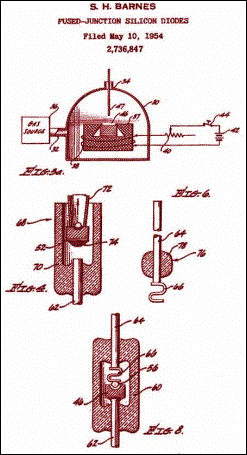
brittleness. My patent (2,736,847),
filed in 1954, directly addressed these difficulties – I presented a paper
“A Silicon Junction Diode Sealed in Glass” at the 1954 AIEE in NY. Large scale manufacturing of these
diodes began immediately thereafter at Hughes.
|