|
EARLY
TRANSISTOR HISTORY AT GE Jerry Suran – The Story of the Unijunction Transistor |
|
|
Oral History – Jerry Suran (Continued) |
|
|
|
|
|
|
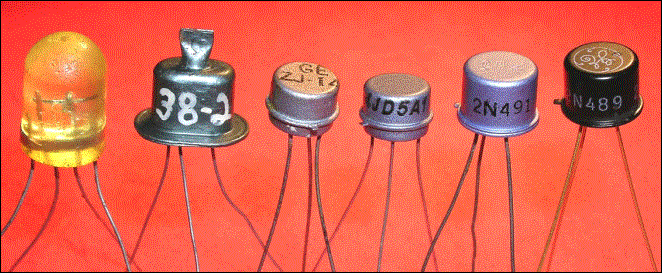
Shown above are various
prototype, pre-production and commercial versions of early General Electric
unijunction transistors. The two
leftmost units are germanium prototypes from 1953/54. Beginning in 1956, silicon was used
instead of germanium for unijunction device fabrication. The type “ZJ-14” shown above represents an
early silicon pre-production unit and was the precursor of the commercial
type 4JD5A1, which was introduced by GE in 1957. Standard JETEC “2N”
designations were established by GE for unijunction transistors in the late
1950s, with the series 2N489, 2N490, 2N491, 2N492, 2N493 and 2N494. These
were all silicon unijunction devices, with differing performance
characteristics. The earliest
versions used a blue metal case (the 2N491 shown above is dated 1961). The
later versions had a black metal case (the 2N489 shown above is dated 1963).
The 2N489-494 series was established as a Mil-Standard type device. General Electric was the
primary manufacturer of unijunction transistors throughout the 1950s and
1960s, with Texas Instruments and Motorola providing second source
types. These original unijunctions
were known as “bar-type”, based on the construction process using a single
bar of silicon. As additional
transistor manufacturing processes were developed in the industry, some of
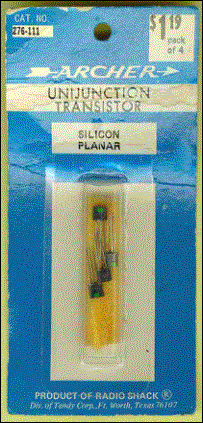
these techniques were applied to unijunction types. Shown on the left is an example of low cost planar unijunctions
developed in the 1960s.
|
|
COPYRIGHT
© 2005 by Jack Ward. All Rights
Reserved. http://www.transistormuseum.com/ PAGE
9 |
|